



Decision-making in Parkinson’s disease: from evidence to care
Parkinson’s disease affects more than movement. Executive changes can alter how a person weighs risk, learns from feedback and decides when confidence has outweighed caution.
These shifts are rarely uniform. Fatigue, anxiety, depression, sleep disruption, medication state and mild cognitive impairment can all influence judgement, so a difficult choice is not automatically impaired thinking.
Neuropsychological assessment can clarify that pattern, but useful care connects neuroscience with humane treatment, cultural expectations and the realities of daily life.
How Parkinson’s disease alters decisions
Loss of dopaminergic neurons changes signalling across frontostriatal circuits, including the orbitofrontal and medial prefrontal cortex. These networks help update expected rewards, value possible outcomes and inhibit impulsive responses. Parkinson’s disease can therefore affect risk–reward weighting, reversal learning and persistence under uncertainty.
Patterns vary across people and over time. Some choose slowly but accurately; others respond quickly while neglecting long-term consequences. In Australian settings, plain phrases such as “brain fog” and “on and off times” often convey more than “executive dysfunction”, so clinicians should ask what each term means.
Consequences may first appear around driving, work, finances or relationships. Changes in familiar roles often say more than performance on an unfamiliar computer task.
Medication, emotion and impulse control
Levodopa, dopamine agonists and other dopaminergic treatments can improve motor function and sometimes cognitive performance, but benefit may fluctuate. Testing during an “off” period may reflect bradykinesia, fatigue or anxiety rather than a stable deficit, making medication timing essential to interpretation.
Impulse-control difficulties, including compulsive gambling, spending, eating or sexual behaviour, can also emerge in association with treatment. They warrant direct, non-judgemental enquiry and review of medication changes, not blame. Apathy and depression may produce the opposite picture: reduced initiation despite intact reasoning.
What the Prague meeting contributed
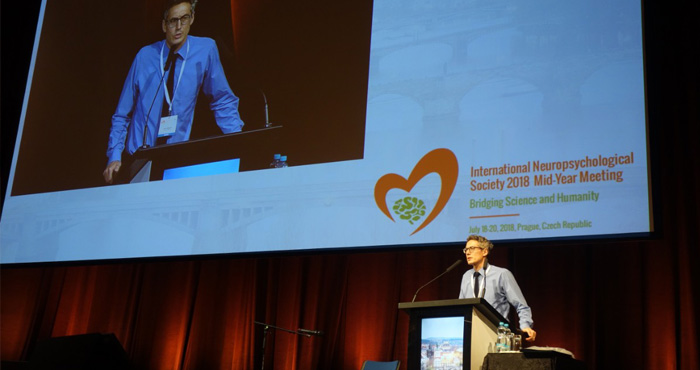
The INS 2018 Prague meeting, held from 18–20 July 2018, connected scientific advances with patient care, cultural considerations and clinical practice. Its program, poster listings and continuing education workshops provide a traceable record of the evidence considered at the time.
For Australian clinicians, the transferable lesson is to meet the person in their context. Pathways often combine Medicare-subsidised neurology services after a GP referral, private consultations and NDIS funding for eligible disability-related supports. Explaining fees, report purpose and referral requirements reduces confusion.
Comparing approaches to assessment
No single measure captures the construct. Assessment should combine performance tasks, everyday behaviour, mood and medication history, then check whether findings converge.
| Method | What it adds | Clinical strength | Caution |
|---|---|---|---|
| Probabilistic reasoning task | Reward weighting and feedback learning | Allows within-person comparison | Familiarity with the rules can influence performance |
| Choice or gambling task | Reversal learning and risk taking | Briefly reveals strategy changes | Scores are not standalone indicators of impairment |
| Daily-choice and symptom diary | Fluctuations in real-world choices | Captures context and functional impact | Requires consistent follow-up and good adherence |
| Clinical interview with collateral | Changes in money, driving or relationships | Connects behaviour with everyday consequences | Reporter bias and privacy require careful consent |
Performance also depends on vision, education, language and cultural familiarity. A low score needs context: did the person misunderstand the rules, feel uncomfortable with the stakes or distrust the examiner? Financial capacity is decision-specific; difficulty managing money does not automatically mean an inability to consent to treatment.
Translating evidence into patient care
Assessment should establish what the person can decide, what has changed from baseline, and which supports preserve valued activities. Where possible, compare performance with earlier records and obtain collateral history with consent. Decisions about treatment, driving or finances should focus on the specific choice, its consequences and available communication support.
Shared decisions require plain explanations of uncertainty. Clinicians can draw on clinical practice resources when explaining cognitive changes, while checking that any material fits the person’s diagnosis, language and goals. The aim is not to remove every risk, but to support choices the person understands and values.
Practical priorities for Australian clinics
For Aboriginal and Torres Strait Islander clients, decisions may involve kinship, community obligations and cultural priorities. Listening before testing, involving an Aboriginal health worker when requested, and avoiding assumptions about individualistic decision-making can protect trust. Multilingual patients need qualified interpreters rather than relatives for complex consent discussions.
Regional and remote Australia adds another layer. Telehealth can preserve specialist access when travel would consume a day, but bandwidth, hearing and connection reliability need checking. A technically completed assessment is not necessarily clinically adequate.
- Record medication timing, on/off state, sleep and mood beside decision scores.
- Pair laboratory performance with everyday choices and consented collateral information.
- Ask directly and without judgement about gambling, spending, sexual behaviour and recent medication changes.
- Treat consent and capacity as specific to the decision, using supported decision-making where appropriate.
- Build cultural consultation, interpreter access and telehealth planning into referral pathways.
In Melbourne, extra time after a tram journey and a quieter waiting space can help separate fatigue from cognitive impairment. Sound care distinguishes neurological change from the pressures surrounding a decision and arranges support around what matters to the person.
General Information
Important information about the meetingIndustry
Support and exhibition opportunitiesCzech Republic
Beautiful country situated in the very heart of EuropeContact
How can we help you?
Prague Congress Centre (KCP)
5.května 65140 21 Prague 4
Czech Republic
Phone: +420 261 171 111
Website: www.kcp.cz